

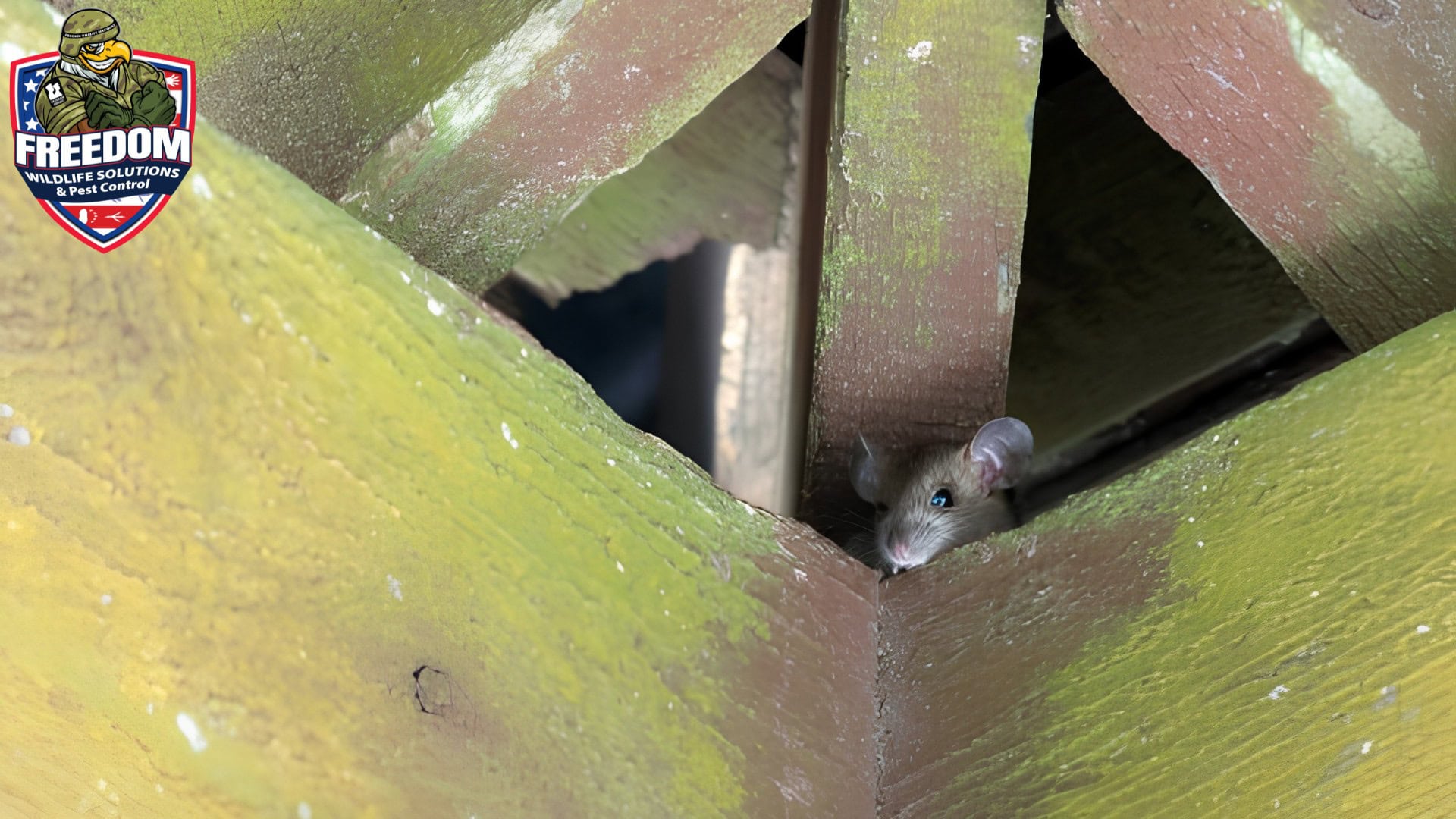
Roof Rats vs. Norway Rats: How to Tell Which Rat Is in Your Raleigh Home
You hear something moving in the attic at night. Or you pull out from under the kitchen sink and find a scatter of dark, pellet-shaped droppings. You already know you’ve got a rat. But here’s the question most Raleigh homeowners never think to ask: which rat?
It matters more than you’d guess. The two rats that get into Triangle homes — the roof rat and the Norway rat — behave like opposites. One climbs and nests high. The other burrows and stays low. Where you find the signs, how you seal the house, and where the traps go all depend on which one you’re dealing with.
Here’s what you need to know to tell them apart — and what to do once you do.
First, Why It Matters Which Rat You Have
A rat is a rat, right? Not when it comes to getting rid of one. Roof rats and Norway rats use your house in completely different ways. Set traps for the wrong species in the wrong spot and you’ll catch nothing while the problem keeps growing. We’ve seen homeowners fight a rat in the kitchen for weeks when the colony was living in the attic the whole time.
Get the identification right and everything else falls into place — the entry points to seal, the areas to inspect, where the traps actually belong. That’s the whole game with rats.
Meet the Two Rats That Get Into NC Homes
Of all the types of rats out there, only two regularly move into houses here in North Carolina. Once you know what separates them, you’ll never confuse the two again.
The Norway Rat — the “ground” rat
Also called the brown rat or sewer rat, the Norway rat is the big one. Adults run about 7 to 9 inches in the body, with a thick, heavy build, small ears, a blunt nose, and a tail that’s shorter than its body. The fur is coarse and brown to gray.
Norway rats are diggers. They burrow along foundations, under sheds and concrete slabs, in woodpiles, and into crawl spaces. Inside, they stay low — basements, crawl spaces, the ground floor, and behind appliances. If your trouble is down at ground level, this is usually your rat.
The Roof Rat — the “attic” rat
Also called the black rat, the roof rat is smaller and leaner — about 6 to 8 inches in the body, with a sleek build, large ears, a pointed nose, and a tail that’s longer than its body. The fur is smooth and brown to black.
Roof rats are climbers. The name says it all. They travel power lines, fence tops, and tree branches, and they nest high — attics, rafters, upper cabinets, and dense vines or shrubs outside. If your scratching is coming from overhead, this is almost certainly your rat.
Roof Rat vs. Norway Rat: The Quick Comparison
When you stand the two side by side, the differences are easy to spot:
- Body: The Norway rat is heavier and bulkier; the roof rat is smaller and sleeker.
- Tail: The Norway rat’s tail is shorter than its body. The roof rat’s tail is longer than its body — one of the best single tells.
- Ears and nose: Norway rats have small ears and a blunt nose. Roof rats have large ears and a pointed nose.
- Where they live: Norway rats stay low — burrows, crawl spaces, ground floor. Roof rats go high — attics, rafters, trees.
- Droppings: Norway rat droppings are about 3/4 inch with blunt, rounded ends. Roof rat droppings are about 1/2 inch with pointed ends.
If you only remember one thing, remember tail length and height. A long-tailed rat up high is a roof rat. A heavy, short-tailed rat down low is a Norway rat.
Where Each One Hides in Your Home
This is where the identification pays off. With a Norway rat, we inspect from the ground up — the crawl space, the foundation line, the garage, behind the water heater, and any burrows around the exterior. A Norway rat burrow looks like a smooth, two-inch hole in the ground, often next to the foundation, a slab, or a woodpile, with a worn path leading away from it.
With a roof rat, we work from the top down — the attic, the soffits, the rafters, the upper cabinets, and the trees and vines that touch the roofline. A roof rat nest is usually a ball of shredded insulation, paper, or plant material tucked into an attic corner or buried in the insulation. Same house, opposite ends. That’s why guessing wrong costs you weeks.
Reading the Signs: Droppings, Nests, and Sounds
Most of the time you’ll hear or find the evidence long before you ever see the rat. Here’s how to read it:
- Droppings: Bigger, blunt-ended droppings near the ground point to a Norway rat. Smaller, pointed droppings up in cabinets, on rafters, or in the attic point to a roof rat.
- Nests and burrows: Burrows in the yard and along the foundation mean Norway rats. Nests of shredded material up high mean roof rats.
- Sounds: Scratching and scurrying overhead at night is the roof rat’s calling card. Noise in the walls, floors, or crawl space usually means Norway rats.
- Grease marks and gnawing: Both leave dark, greasy rub marks along their travel routes and gnaw on wood, wire, and plastic. Roof rats leave those marks higher up; Norway rats leave them low.
Roof Rat or Just a Mouse?
Plenty of homeowners hear something in the attic and assume “mouse.” Size is the giveaway. A mouse is tiny — two to four inches in the body, with droppings the size of a grain of rice. A roof rat is much larger, with a longer body and a tail longer than that. If the droppings look like rice, you’re likely dealing with mice. If they’re closer to the size of a raisin and pointed at the ends, you’ve got a roof rat. Either way, the fix starts the same way: find how they’re getting in and shut the door.
Why Summer Is the Time to Get Ahead of Rats
A lot of folks think of rats as a cold-weather problem. They’re not. Rats breed hard through the warm months, and right now — in the heat of a Raleigh summer — populations are building fast in attics, crawl spaces, and yard burrows. A pair of rats can turn into a serious infestation by fall.
That matters because fall is when rats push indoors in force, looking for warmth and a place to ride out the winter. The colony that’s quietly growing in your attic or under your slab in June is the one that takes over the house in October. Getting ahead of it now — while the numbers are still small and you can see exactly which rat you’re up against — is far easier than fighting an established colony later.
How We Get Rid of Rats — and Keep Them Out
At Freedom Wildlife Solutions & Pest Control, we treat a rat problem as two jobs in one. First comes the seal-up. We find every entry point — the gaps along the foundation, the soffit openings, the gaps where pipes and wires enter — and close the house off. Trapping rats without sealing the house just makes room for the next ones to move in. We’re a pest control company that specializes in wildlife removal, so that thorough exclusion work is exactly what we’re built for.
Then comes ongoing protection so the population doesn’t rebuild. That’s why rodent coverage is part of our Standard Defense and Premium Guard plans — not as a one-time visit, but as continued protection on the pests most likely to keep testing your home. If you want to dig into the details, here’s a closer look at our
→ professional rodent control program, our dedicated page for rodent control in Raleigh, and the full range of wildlife and pest services across Raleigh and the Triangle.
Here’s what that looks like for our Raleigh customers:
“Everyone who worked on our Raleigh house to resolve our mouse problem were professional and did an excellent job. I’d recommend Freedom Wildlife Solutions without hesitation. David, Matthew, Daniel, and Chris – thank you!”
— Shayna C., Raleigh, NC (Google review)
Don’t Wait for the Colony to Grow
Whether it’s a Norway rat burrowing under your crawl space or a roof rat running your rafters, the problem only gets bigger — and more expensive — the longer it sits. The good news is that once you know which rat you’ve got, it’s a very fixable problem.
If you’re in Raleigh, Clayton, Cary, or anywhere in the Triangle and you think you’ve got rats, call Freedom Wildlife Solutions & Pest Control at (919) 584-8650. We’ll identify exactly which rat you’re dealing with, seal the house up tight, and keep it that way. Don’t wait.
Frequently Asked Questions
What’s the difference between a roof rat and a Norway rat?
Norway rats are larger and heavier with small ears, a blunt nose, and a tail shorter than their body, and they live low — in burrows, crawl spaces, and on the ground floor. Roof rats are smaller and sleeker with large ears, a pointed nose, and a tail longer than their body, and they live high — in attics, rafters, and trees.
How can I tell which rat is in my house?
Use location and tail length. A rat heard or found up high (attic, rafters, upper cabinets) with a long tail is almost always a roof rat. A heavy rat found low (crawl space, basement, ground floor) or burrowing in the yard is almost always a Norway rat. Droppings help too: Norway rat droppings are larger with blunt ends, roof rat droppings are smaller with pointed ends.
Are roof rats or Norway rats more common in the Raleigh area?
Both are found throughout the Triangle. Norway rats are the more common house rat across much of North Carolina, but roof rats are very much here too — especially in older, tree-heavy neighborhoods where they can travel the canopy and reach the roofline. Many homes end up dealing with one or the other depending on the surrounding cover.
What do roof rat droppings look like compared to Norway rat droppings?
Norway rat droppings are about 3/4 inch long with blunt, rounded ends and are usually found near the ground. Roof rat droppings are about 1/2 inch long with pointed ends and are usually found up high — on rafters, in cabinets, or in attic insulation.
How do I get rid of rats for good?
Trapping alone won’t do it. The lasting fix is sealing every entry point so new rats can’t get in, removing the rats already inside, and then keeping up ongoing protection so the population doesn’t rebuild. A professional can identify the species, find the entry points you’ll miss, and handle the seal-up correctly.
