- VETERAN-OWNED · WILDLIFE-GRADE RODENT CONTROL
Rodent Control & Removal
Most companies toss out bait and leave. We start like a wildlife job — find every way rats and mice are getting in, remove them, and seal your home wildlife-grade so they don’t come back. Veteran-owned, 500+ five-star reviews.
Prefer to talk?
RODENT CONTROL, DONE RIGHT
Rat Control, Mouse Control, and Rodent Removal — One Job, Done Right
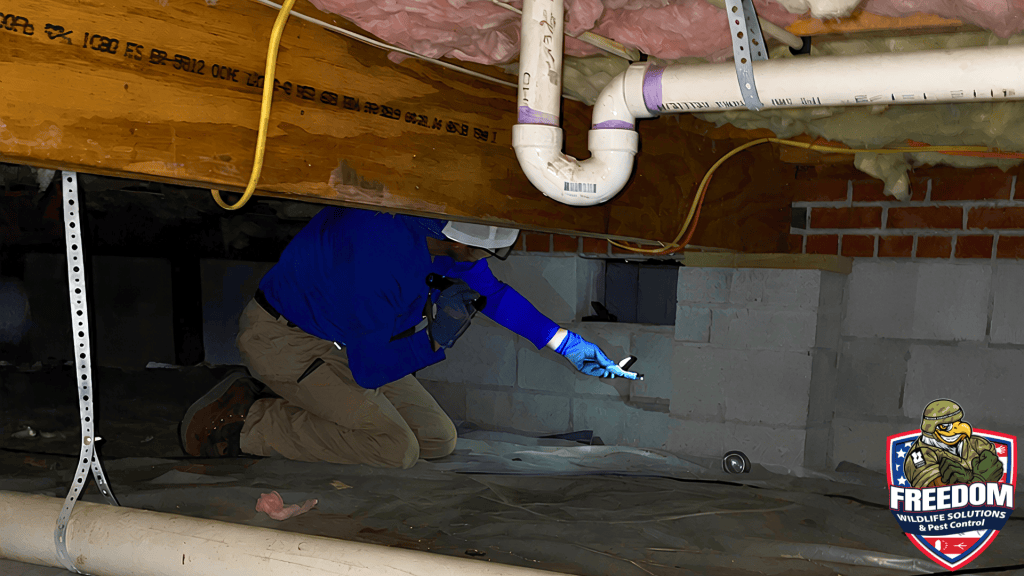
Rat control, mouse control, rodent removal — whatever you searched for, it’s the same job done right. Rodents are where wildlife work and pest work meet, so we handle them like a wildlife job: a full inspection to find every way rats and mice are getting in — crawlspace vents, foundation gaps, chewed openings, utility penetrations — then a thorough wildlife-grade seal-up. Sealing the home is what actually ends the problem; baiting without sealing only thins the population and lets the next rodent right back in.
Once the home is sealed, ongoing protection keeps it that way — exterior monitoring and rodent stations around your property that hold the population down and catch new activity early, before it becomes another problem inside. Freedom Wildlife Solutions & Pest Control is a Triangle-based, veteran-owned company serving central North Carolina, backed by 500+ five-star reviews from homeowners across the region.
WHY FREEDOM
Why Homeowners Choose Freedom for Rodent Control
We Seal the Entry Point
Wildlife-grade exclusion: heavy mesh on crawlspace vents, aluminum-clad doors, structural seal-up — so rodents can't get back in.
A Pest Company That Specializes in Wildlife
The seal-up approach that actually ends a rodent problem, not just thins the population.
Veteran-Owned & Local
Veteran-owned and operated since 2018, Triangle-based — your neighbors, not a national franchise.
Licensed & NWCOA-Affiliated
Licensed, insured, trained, and affiliated with the National Wildlife Control Operators Association.
500+ Five-Star Reviews
Trusted by hundreds of homeowners across central North Carolina.
Sealed, Then Protected
Ongoing exterior monitoring on our Standard and Premium plans holds the population down — and the exclusion is backed by a warranty.
Rodent work is one of our most common jobs — and the one where sealing the home, not just baiting it, is the difference between a real fix and a callback.
REVIEWS
What Central NC Customers Say
“I was really impressed with this company. We have had ongoing issues with rodents (mice and rats) getting into both our crawlspace and our attic. Ken came out and did a super thorough inspection, crawling all around our crawlspace, exploring our attic, getting on the roof, and doing a full inspection of the perimeter of the house. When it came to doing the work, David and Matt were excellent — thorough and meticulous. It is surprisingly hard to find companies that offer rodent exclusion services instead of just ongoing trapping/poisoning, and I am so grateful I found a company that does it (and does it well).”
Erin, NC
I called Freedom Wildlife Solutions to get a home inspection because we caught a mouse. Leland came and did the inspection. He found places the mice could enter the house and also found evidence of bats in the attic. While in the attic, Leland also spotted an area that had been leaking due to a roofing problem. He went on the roof and found several issues. The roofers and another company that installed the gutter guards both did a poor job resulting in several areas pests can enter the house and also poor draining from the roof. Freedom Wildlife Solutions did some much needed repairs on the roof and referred me to a roofing company to do some other needed repairs. I also signed up for the pest control program. Joseph came out to do the initial service. He took his time removing cobwebs and treating the outdoors. Joseph also treated under all the sinks after I told him about the roaches that I have seen in the house. I highly recommend Freedom Wildlife Solutions for all your pest control needs. I had a follow-up phone call from the office checking on the service we received and asking if we had other needs that need addressing. Freedom Wildlife Solutions is a company that has great employees and truly care about their customers!!
Marlette Truitt, NC
THE RODENTS WE HANDLE
Rodents Common in Central North Carolina
Central NC homes deal with a predictable mix of rodent species — each with different habits, habitats, and entry points. Getting the species wrong is one reason DIY almost never ends a rodent problem.
Rat Control vs. Mouse Control — Know What You Have
Getting the species right is half the job. Rats leave larger droppings, wear defined greasy runways along walls and beams, and do heavier gnaw and structural damage; they push in through siding gaps, roof intersections, crawlspace vents, and utility lines. Mice leave smaller droppings, slip through much finer cracks — under doors, around pipes, a dime-sized hole — and multiply faster (one female can have 5–10 litters a year). We confirm which one you have during the inspection, before we set a single trap.
Mice We Treat
House Mouse
The most common indoor invader — kitchens, pantries, wall voids. One female can produce 5–10 litters a year.
White-Footed Mouse
Common in wooded and rural subdivisions. Enters attics and outbuildings; a known hantavirus carrier.
Deer Mice
On rural properties bordering farmland — Wayne, Johnston, and Harnett see steady pressure at fall harvest.
Rats We Treat
Norway Rats
Larger rats that den in crawlspaces, basements, and near drainage; burrow around foundations. Common in older downtown Raleigh, Durham, Goldsboro, and Fayetteville.
Roof Rats
They work overhead — attics, soffits, mature-tree neighborhoods. Heaviest in North Raleigh, Cary, and canopy-heavy Triangle subdivisions.
KNOW THE SIGNS
Signs You May Need Rodent Control
Most rodent problems start quietly — a noise overhead at dusk, droppings under the sink, a small chewed opening near the foundation. Here are the signs central NC homeowners call us about most. If any sound familiar, call (919) 584-8650 — catching it early is dramatically cheaper than waiting it out.
Noises You Can Hear
- Scratching or scurrying in walls, ceiling, or attic — usually at dusk
- Quick patter or thumping above the ceiling — often Roof Rats on beams
- Gnawing in walls or cabinets — rodents chew constantly
- Squeaks or chittering — an active nest with young
Things You Can See
- Droppings in cabinets, behind appliances, garage, or attic
- Chewed wires (a fire risk), food packaging, wood, or insulation
- Greasy rub marks along baseboards, foundation, or beams
- Dime-sized or larger holes near the foundation or utilities
- Nests of shredded paper or insulation; daytime sightings
Things You Can Smell
- A musty, ammonia-like odor in the attic, crawlspace, or near a wall — urine build-up
- A sudden, powerful odor over a few days — usually a dead rodent in a wall. Call same-day.
Other Telltale Signs
- Pets fixating on walls, cabinets, or the fireplace
- Pet food disappearing or bags chewed open overnight
- A dryer that suddenly takes longer to dry (nest in the vent)
- Attic insulation that looks compressed or trampled
OUR PROCESS
Our Rodent Control Process
Solving a rodent problem the right way is a structured job — not a bait station left for a week. The order matters: we seal first like a wildlife job, then layer in recurring protection like a pest plan.
1. Thorough Inspection
A full inspection — crawlspace, attic, perimeter, roofline, and every utility penetration. We identify the species, every entry point, and the damage, then give you a written quote before any work begins.
2. Trapping & Removal
We trap and remove the active population — often dozens of traps in the crawlspace and key zones — and return to verify it’s fully resolved, not just quieter. Most companies treat this as the whole job. For us it’s step two of five.
3. Wildlife-Grade Exclusion — the Seal-Up
The part most companies skip — and the reason their customers keep calling back. We seal every entry point with wildlife-grade materials: heavy mesh on crawlspace vents, structural seal-up at gaps and chewed openings, chew-proof reinforcement at utility penetrations, and aluminum-clad crawlspace doors when needed.
4. Sanitation & Cleanup
After the rodents are out and the home is sealed, we remove droppings and contaminated insulation, sanitize the space, and replace insulation where needed. We handle it in-house — most pest companies don’t offer it.
5. Recurring Protection & Warranty
Once sealed and clear, ongoing protection keeps it that way. Rodent control is included on our Standard and Premium plans — recurring visits plus exterior monitoring — and the exclusion is backed by a warranty: if rodents get back in through what we sealed, we come fix it.
Hearing Scratching at Night? Let’s End It.
Free inspection, an honest quote, and a real fix — sealed, not just baited. We’ll get you on the schedule and end the problem the right way.
SERVICE AREA
Our Rodent Control Service Area
Headquartered in Clayton, we handle rodent control across nine counties in central North Carolina — and every city below has its own rodent control page. Can’t find your city? Call (919) 584-8650.
WHY HERE
Why North Carolina Homes Get Rodent Calls
Central North Carolina is a year-round rodent environment. The Piedmont climate — warm humid summers, mild winters, abundant rainfall — keeps rodent populations active twelve months a year, with seasonal spikes in fall and early spring. The mix of urban density (Raleigh, Durham, Fayetteville), suburban sprawl (Cary, Apex, Holly Springs, Clayton), and rural-agricultural counties (Johnston, Harnett, Wayne) creates every kind of rodent pressure point: older downtown homes with crawlspace gaps, newer subdivisions with utility penetrations, rural properties bordering farmland, and wooded lots backing up to wildlife corridors. Whether your home is in a Triangle subdivision or on a Johnston County farm road, the fix is structural — not a bait box.
Fall · Sep–Nov
Rodents push toward homes as outdoor food shrinks and temperatures drop. Wayne and Johnston County properties near farm fields spike when corn, soybeans, and sweet potatoes are harvested.
Winter · Dec–Feb
Established indoor populations breed and spread within wall voids and attics. Activity may be quieter, but the damage compounds.
Early Spring · Mar–Apr
Population peaks. The young from winter litters are now mobile, and entry-point exploration intensifies as breeding behavior ramps up.
Summer · May–Aug
Outdoor populations are highest; indoor pressure shifts toward attics and dryer vents — Roof Rats in particular.
FAQ
Frequently Asked Questions About Rodent Control
How much does rodent control cost?
It depends on the species, the access points, and how much sealing the home needs. We do not quote rodent jobs over the phone because every home is different. Call (919) 584-8650 to schedule an inspection — we will give you a clear quote after we have walked the property.
Do you just put out bait boxes?
We use bait strategically, but bait alone never ends a rodent problem — it just thins the population. We seal every entry point first (wildlife-grade exclusion), then keep the population down with exterior monitoring and stations as part of ongoing protection. Sealing is what ends it; the ongoing service keeps it that way.
How do you tell if it's rats or mice?
We read the evidence — droppings, gnaw marks, runways, and the size of the openings. Rats leave larger droppings, defined travel paths, and heavier damage; mice leave smaller droppings and use finer gaps. We confirm the species during the inspection so the plan is built for what you actually have, not a guess.
Are mice and rats dangerous?
Yes. They chew wiring (a real fire risk), contaminate food and prep surfaces, and carry pathogens — hantavirus, leptospirosis, salmonella, and listeria among them. Catching a rodent problem early saves a lot of repair, and a lot of risk.
How long does it take to get rid of rodents?
Most homes see activity drop within a few days of the first service. Full control usually takes one to two weeks, depending on the size of the population and how many entry points we’re sealing. We keep monitoring until it’s actually resolved — not just quieter.
How should I prepare for my rodent service?
Give us clear access to the attic, crawlspace, garage, and utility rooms, and pull stored items a few feet off the walls so we can find entry points and activity. Cleaning up spilled food and securing trash helps too. We’ll flag anything specific to your home when we schedule.
Is rodent control included on your pest control plans?
Yes — on Standard Defense and Premium Guard plans. Economy Shield does not include rodent. Recurring plans are quoted alongside the initial rodent work after the inspection.
Will the rodents come back?
Not when the structure is sealed correctly. Our exclusion work is backed by a warranty: if rodents get back in through what we sealed, we come back and fix it.
What are the most common signs I need rodent control?
Scratching or scurrying in walls or attic at dusk, droppings in cabinets or the garage, chewed wires or food packaging, greasy rub marks along baseboards, a musty ammonia smell from an attic or wall, and pet behavior changes (fixating on walls). Fall is the peak season across central NC, especially in agricultural areas where harvest pushes rodent populations toward homes.
What areas of North Carolina do you serve?
We serve nine counties across central NC from our Clayton headquarters: Johnston, Wake, Durham, Harnett, Cumberland, Lee, Wilson, Wayne, and Nash. See the Service Area section above for our city-specific pages, or call (919) 584-8650.
What if my home is too far from Clayton?
We make the drive to most of central NC. Some routes are easier than others — coastal NC and the western mountains are outside our service area, but the Triangle, Sandhills, and Coastal Plain edge are all covered. Call (919) 584-8650 to confirm coverage for your specific address.
One team finds every entry point, removes the rats and mice, and seals your home wildlife-grade so they can’t come back. Veteran-owned, licensed, and 500+ 5-star reviews by Triangle homeowners.