

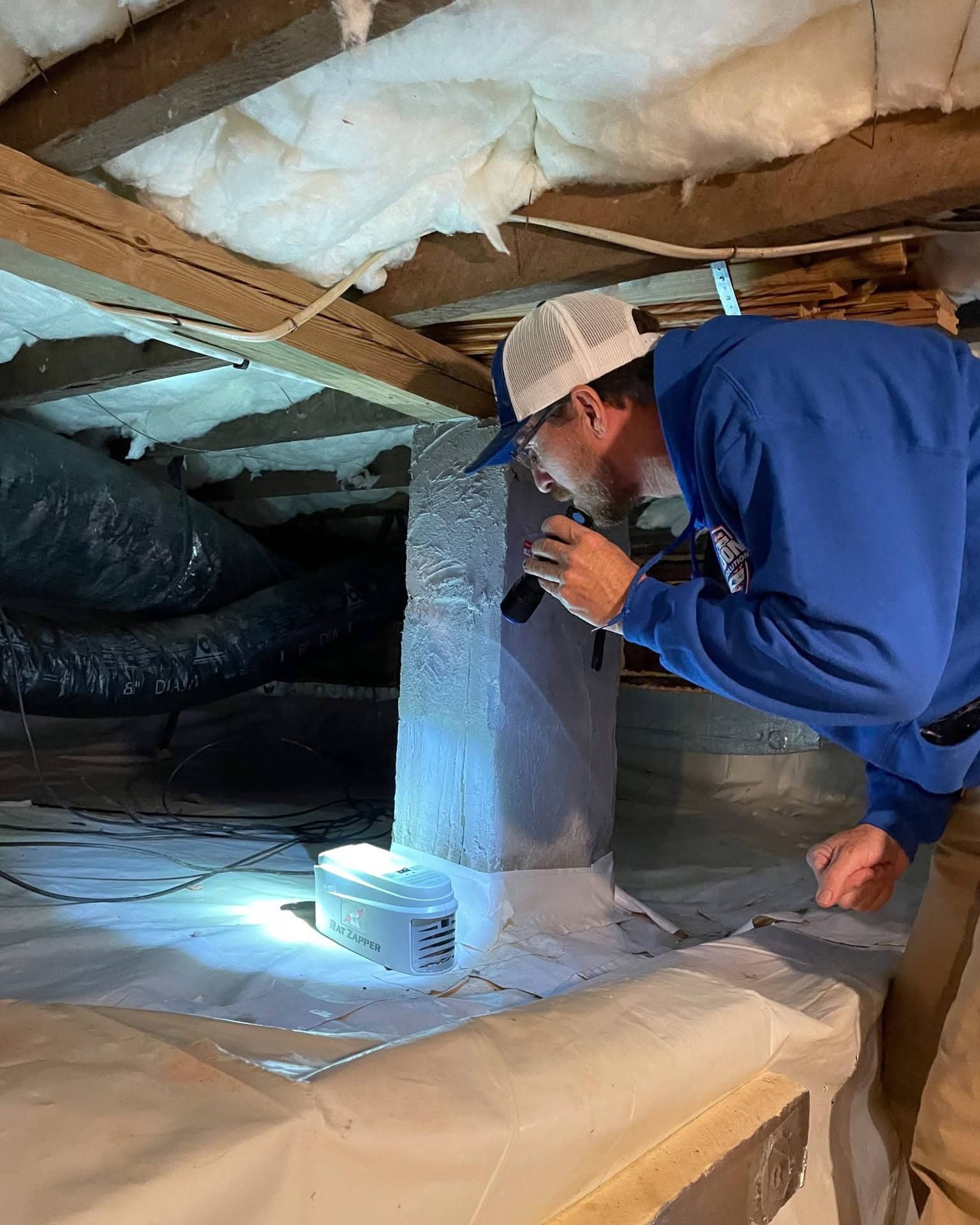
Rodents in Your Crawl Space? Here’s How They Get In — and How to Get Them Out
There’s a part of your house you almost never look at, and rodents know it. If your home sits on a crawl space, you’ve got the most attractive piece of real estate a rat or mouse could ask for — dark, quiet, warm in winter, and nobody goes down there for months at a time.
Across Raleigh, Clayton, Garner, and the rest of the Triangle, a huge share of our housing stock sits on a vented crawl space rather than a slab. We’ve pulled rodents out of hundreds of them. In most of those homes, the owner had no idea anything was down there until something tipped them off upstairs.
Here’s what you need to know.
Why Crawl Spaces Attract Rodents
A crawl space checks every box a rodent has. That’s not bad luck — it’s design.
- Shelter and darkness. No foot traffic, no light. A rat can live under your floor for months unseen.
- Temperature. Cooler than outside in summer, considerably warmer in winter.
- Nesting material. Fiberglass batt insulation is close to perfect. Rodents shred it and nest inside it.
- Moisture. Rodents need water, and a damp crawl space or a slow drip supplies it.
- Cover on the approach. Shrubs and woodpiles let a rodent reach your vents without crossing open ground.
Put that together and you don’t have a house with a crawl space. You have a nesting box with a house on top of it.
How They Actually Get In
People picture a rat squeezing through some obvious gap. The real openings are lower, smaller, and duller than that:
- Foundation vents — screens rust out, get bent, or were never sized to stop rodents.
- The crawl space access door — warped or ill-fitting, and often the largest opening in the foundation.
- Utility penetrations — every spot a water line, gas line, HVAC lineset, or conduit passes through.
- Gaps at the sill plate, where framing meets block or brick. Rarely sealed tight on an older home.
- Foundation cracks and mortar gaps that widen as the house settles.
Size is what people underestimate. A mouse gets through an opening about the width of a pencil. A rat needs roughly the size of a quarter. If your little finger fits in a gap along your foundation, treat it as an entry point.
Signs You’ve Got Rodents Under Your Floor
You don’t need to crawl under the house to know. The signs show up where you live:
- Scratching or scurrying under the floor after dark. Under the floor rather than overhead is the tell.
- A musky, ammonia-like smell through floor vents, or an odor near the HVAC when it kicks on.
- Droppings in the garage, utility room, or the back of low cabinets.
- Cold floors or rooms that won’t hold temperature — often shredded, displaced insulation underneath.
- Greasy dark rub marks along foundation walls, vents, or the access door.
- Torn insulation visible from the access hatch, or a vent screen chewed or pushed in.
One of those alone may mean nothing. Two or three together, and something is living under your floor.
It Never Stays in the Crawl Space
This is the part we wish more homeowners understood: a crawl space rodent problem isn’t a crawl space problem. Once rodents are established underneath, they follow your utilities up. Plumbing chases, HVAC penetrations, and wall cavities run from that crawl space straight into your kitchen and laundry room — and in plenty of homes, all the way to the attic. The crawl space isn’t the destination. It’s the lobby.
And the damage compounds while you’re not looking:
- Chewed wiring. Rodents gnaw constantly to manage their teeth, and wiring under a floor is an easy target. That’s a real fire risk, not a talking point.
- Destroyed insulation. Shredded and contaminated batt stops insulating. Your HVAC works harder and your bills climb.
- Ductwork damage. A chewed duct dumps conditioned air under the house and pulls crawl space air into what you breathe.
- Contamination. Droppings and urine build up in the insulation and soil. The CDC recommends against dry-sweeping rodent droppings for good reason.
A rodent problem under your floor doesn’t get cheaper by waiting.
Why DIY Usually Falls Short Down There
We’re not going to tell you a homeowner can’t set a trap. Plenty of people catch a rodent or two under the house. The issue is what happens next. Traps handle the rodents already inside — they do nothing about the openings that let them in. So you catch a few, the noise stops for a couple of weeks, and then it comes right back, because the crawl space is exactly as accessible as it was before.
- You can’t inspect what you can’t reach. Finding every entry point means going wall to wall along the foundation, in the dark, on your stomach.
- Poison creates a second problem. A rodent that dies inside a wall is a smell you’ll live with for weeks.
- Contaminated material isn’t a shop-vac job. Disturbing droppings without proper PPE and containment is how people get exposed.
- Foam alone doesn’t hold. Rodents chew straight through it. Sealing that lasts uses metal, hardware cloth, or mortar.
What Actually Ends It
A crawl space rodent job that holds up follows the same sequence every time:
- Full inspection. The whole crawl space wall to wall, plus the exterior foundation. Map every entry point, find the nesting areas, document the damage.
- Knock down the active population. Trapping placed on the actual runways and rub marks — not guesswork.
- Seal the structure. Every entry point closed with material rodents can’t chew: vent screening, hardware cloth, sheet metal, mortar. This is the step that ends the cycle, and the step most people skip.
- Clean up what’s left. Contaminated insulation out, space disinfected, vapor barrier repaired, re-insulated. Otherwise the scent trail is still down there advertising the space.
- Keep it that way. Ongoing service keeps pressure on the exterior population so the next generation doesn’t start over on your foundation.
Steps 3 and 4 are where jobs get won or lost. Trapping alone is a rental agreement. Sealing is an eviction.
What You Can Do Right Now
None of these require going under the house:
- Cut back shrubs and ground cover touching the foundation. Take away the cover on the approach.
- Move woodpiles and stored materials off the house. A woodpile against the foundation is a staging area.
- Check vent screens and the access door from outside. Anything rusted, bent, chewed, or not flush is a gap.
- Fix the water — a dripping hose bib, a downspout dumping at the foundation, grading that runs toward the house.
These reduce the pressure. They don’t close the openings already there — that part takes getting under the house.
A Word on Timing
If you’re reading this in mid-summer, you’re in the best window to deal with it. Rodent pressure on Triangle homes climbs hard as temperatures drop and rodents push indoors looking for somewhere warm. The homes that get sealed in July and August are the ones that don’t have a problem in November — and you’re working on your schedule instead of reacting at 2 a.m. in October.
How Freedom Wildlife Solutions & Pest Control Handles It
Freedom Wildlife Solutions & Pest Control is a pest control company that specializes in wildlife and rodent work, and that distinction matters in a crawl space. A company that only sprays treats the perimeter and leaves. The exclusion, the cleanout, and the restoration are the parts that actually end it — and those are the parts we do.
We handle the whole sequence: inspection, trapping, exclusion, and the crawl space cleanout — contaminated insulation out, space disinfected, vapor barrier repaired, re-insulated. Our professional rodent control work is built around sealing the structure, not just knocking the population down. Rodent control in Raleigh is one of the most common calls we run, and the crawl space is where a large share of those jobs start. We work across Raleigh, Cary, Clayton, Garner, and Durham — rodent control in Durham included, where the older housing stock means crawl spaces we know well. Veteran-owned and operated since 2018, out of Clayton.
One more thing worth knowing: once we’ve sealed your home and you’re on a recurring plan with us, that sealed work is covered for life. If something gets back in through an area we secured, we remove it and repair that area at no charge. Rodent coverage rides on Standard Defense (6 scheduled visits per year) and Premium Guard (12 scheduled visits per year) — both cover the pests listed on the plan, and the free re-services are the insurance on that coverage.
“Everyone who worked on our Raleigh house to resolve our mouse problem were professional and did an excellent job. I’d recommend Freedom Wildlife Solutions without hesitation. David, Matthew, Daniel, and Chris – thank you!”
— Shayna C., 5-star Google review (Raleigh • Rodent Control)
Don’t Wait Until It’s in the Walls
Rodents under your floor don’t stay under your floor. Every month they’re down there is more shredded insulation, more chewed wire, more contamination — and a bigger bill when you finally deal with it. The fix isn’t complicated, but it has to include sealing the house, or you’re just renting time.
If you’re in Raleigh, Clayton, Durham, or anywhere in the Triangle and you think something’s living under your floor, give us a call at (919) 584-8650. We’ll get under there, tell you exactly what’s going on, and take care of it.
Frequently Asked Questions
How do rodents get into a crawl space?
Most come in through damaged or missing foundation vent screens, a warped access door, gaps where plumbing and HVAC lines pass through the foundation, unsealed seams at the sill plate, or foundation cracks. A mouse only needs an opening about the width of a pencil; a rat needs roughly the size of a quarter.
What are the signs of rodents in a crawl space?
Scratching under the floor after dark, a musky ammonia-like smell through floor vents, droppings in the garage or low cabinets, floors that feel colder than they should, greasy rub marks along the foundation, and torn insulation visible from the hatch. Any two together usually means active rodents.
Will traps alone get rid of rats in my crawl space?
Rarely for long. Traps remove the rodents already under the house but do nothing about the openings they used to get in. Without sealing those entry points, new rodents move into the same space within weeks. Trapping knocks the problem down; exclusion ends it.
Do I need to replace the insulation in my crawl space after rodents?
Usually, if it’s been nested in or contaminated. Shredded insulation has stopped insulating, and droppings and urine left in place keep the space smelling like an established nest to the next rodent. A proper cleanout removes the contaminated material, disinfects, repairs the vapor barrier, and re-insulates.
When is the best time to deal with crawl space rodents in North Carolina?
Late summer and early fall, before temperatures drop. Rodent pressure on Triangle homes rises sharply as it gets cold and rodents push indoors for warmth. Sealing the foundation in July or August means you’re not dealing with an active infestation in November.
