

Carpenter Bee Removal
Freedom Wildlife Solutions & Pest Control
Are pests and wildlife keeping you up at night? We are your Solution!
Call for a Carpenter Bee Service Consultation Today!
Home » Stinging Insect Control » Carpenter Bee Control
Carpenter Bee Control for Homes Across Central North Carolina
Carpenter bees drill near-perfect half-inch holes into your eaves, deck railings, fascia boards, and any exposed wood softer than treated lumber. The damage builds quietly — one bee, one tunnel — until you see sawdust on the deck or hear woodpeckers tearing into the siding to get at the larvae. Freedom Wildlife Solutions & Pest Control treats the existing gallery, prevents new boring, and works as part of our broader stinging insect control program.
We are veteran-owned and operated. Carpenter bees look like bumblebees but they are not — bumblebees nest in the ground and are beneficial pollinators we leave alone. Carpenter bees damage structures and breed in the same wood every spring if you do not treat.
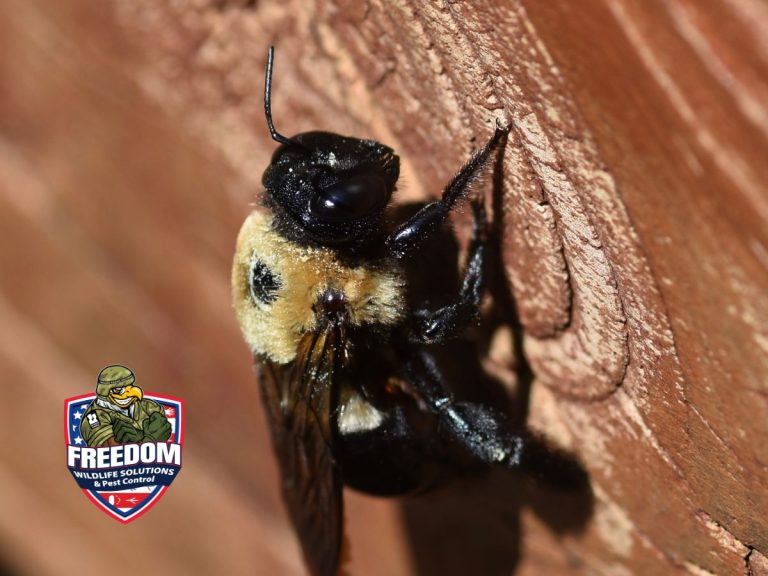
Carpenter Bee vs Bumblebee — How to Tell
- Carpenter bees have a SHINY BLACK abdomen with no hair. Bumblebees have a hairy, yellow-striped abdomen.
- Carpenter bees fly around eaves, deck railings, and wood structures. Bumblebees forage on flowers and ground nest.
- Carpenter bees drill perfectly round half-inch holes into wood. Bumblebees do not damage structures.
- Males hover aggressively near nests and can be intimidating but do not have stingers. Females have stingers but rarely sting unless handled.

Request Your Pest or Wildlife Service Now!
Our Treatment Approach
Gallery Treatment
Targeted dust application directly into each carpenter bee gallery. The dust kills adults and larvae as they move through the tunnel. Single most effective treatment for active galleries.
Entry Hole Sealing
After treatment, we plug the entry holes so new females cannot re-use them next spring. Wood putty plus a hardener works well; we also recommend painting or staining the patched area, as painted wood is significantly less attractive to carpenter bees than raw or weathered wood.
Preventive Perimeter
For homes with chronic carpenter bee pressure, we apply a residual perimeter treatment to common landing surfaces (eaves, fascia, deck rails) at the start of carpenter bee season — typically April. This reduces new boring before tunnels even start.
Secondary Damage from Woodpeckers
The Secondary Damage Most Homeowners Miss
A single carpenter bee tunnel is small. The problem is two-fold. First, carpenter bees return to the same wood year after year, extending existing tunnels and starting new branches — galleries can run several feet through structural lumber over multiple seasons. Second, woodpeckers learn that carpenter bee tunnels contain larvae, and they tear large sections of fascia, soffit, or siding apart to get at them. We see Wake Forest and Cary homes where woodpecker damage exceeds the carpenter bee damage 5-to-1.
Treating the bees stops the woodpecker damage as a side effect. Skip treatment and the woodpecker holes show up next.

Best Carpenter Bee Exterminator
Why Central NC Homeowners Choose Freedom Wildlife Solutions & Pest Control
- Veteran-owned and operated. EPA-registered products applied by licensed technicians.
- We treat carpenter bees specifically — not generic “bee” service that misses the boring pattern.
- 500+ five-star reviews from homeowners across central North Carolina.
Carpenter bees are covered as part of stinging insect control on our recurring pest control plans, so the treatment + prevention is bundled into your seasonal coverage.
Where We Serve
Frequently Asked Questions about Carpenter Bee Removal
How do I know if I have carpenter bees and not bumblebees?
Carpenter bees have a shiny, hairless black abdomen and drill round half-inch holes into wood. Bumblebees have a hairy, yellow-striped abdomen and nest in the ground. If you see large bees hovering around eaves or deck rails, it is almost always carpenter bees.
How much does carpenter bee treatment cost?
Cost depends on the number of active galleries and the extent of preventive perimeter work needed. Spot treatment for a handful of galleries runs lower than whole-property prevention. We quote after the inspection.
Do I really need treatment? They are just one or two bees.
Yes — for two reasons. Carpenter bees return to the same wood every year, extending galleries through structural lumber. And once galleries exist, woodpeckers find them and tear large sections of fascia and soffit apart to eat the larvae. The secondary woodpecker damage often costs more than the bee damage itself.
When is carpenter bee season?
Carpenter bees emerge in April in central NC, peak through May and June, and are still active into early August. Treatment is most effective in April and early May before galleries are heavily established.
Are the treatments safe for pets and kids?
Yes, when applied correctly. Gallery treatments use targeted dust applications inside the tunnel — no surface exposure. Perimeter treatments use EPA-registered products applied to specific landing surfaces. Let surfaces dry before pets and kids return to the treated area.
Schedule Carpenter Bee Control Today
Carpenter bee damage does not fix itself—and it often gets worse over time. If you’re seeing holes in your siding, trim, or fascia, or noticing woodpecker damage, it’s time to act.
👉 Schedule your pest control service today and protect your home with professional carpenter bee control you can trust.
For additional information on stinging insects and safety, visit the CDC’s guidance on insect stings:
https://www.cdc.gov/niosh/topics/insects/default.html