
Bat Removal Durham, NC
Freedom Wildlife Solutions & Pest Control
Are pests and wildlife keeping you up at night? We are your Solution!
Call for a Bat Removal Consultation Today!
Home » Durham County » Durham, NC » Bat Removal Durham, NC
Local Bat Removal Company In Durham, NC
Bats are one of the more urgent wildlife calls we get from Durham homeowners — and for good reason. A bat colony in your attic is not a DIY situation. Between NC wildlife protection laws, the health risks from guano accumulation, and the precision required for proper exclusion, this is a job that needs to be done right the first time.
Durham is particularly prone to bat problems. The city’s older housing stock near downtown, Trinity Park, and Watts-Hillandale provides ideal roost conditions — aged wood, complex rooflines, and gaps that have developed over decades. Duke Forest edge properties see consistent bat pressure year-round.
Freedom Wildlife Solutions & Pest Control is a veteran-owned company serving Durham and all of Durham County. With over 500 five-star Google reviews, we’re the local team that knows NC bat law, knows Durham’s housing stock, and gets the job done right.

Why Durham Homeowners Choose Freedom Wildlife Solutions & Pest Control
We’re not a national franchise. We’re a local, veteran-owned company that does the work ourselves and stands behind it.
- Veteran-owned and operated — discipline and accountability on every job
- NC-licensed and insured for wildlife removal
- We follow NC bat protection law — always, no exceptions
- We don’t perform exclusions during the maternity season (May 1–July 31) or when temperatures are below 50°F
- Humane exclusion only — no poisons, no harm to the colony
- Full exclusion included — we seal every entry point, not just the primary one
- 500+ five-star Google reviews across Wake and Durham Counties
- Same-day inspections available

Request Your Pest or Wildlife Service Now!
What You Need to Know About Bat Removal in North Carolina
Bat removal in NC is governed by state law and biology in ways that significantly affect when exclusion work can be performed. If you call us expecting same-week exclusion, here’s what you need to understand first.
The NC Maternity Season Restriction (May 1 – July 31)
Bats are a protected species in North Carolina. Exclusion work — sealing entry points to prevent bats from returning — is prohibited between May 1 and July 31. This is the maternity season. During these months, bat pups are too young to fly. Sealing entry points during this window traps the colony inside, which is illegal and causes significant damage as the bats attempt to find another exit.
If a company offers to seal your bats in during May through July, walk away. It’s illegal in NC and will make the problem significantly worse.
The Winter Temperature Restriction (Below 50°F)
There’s a second timing factor that goes beyond the law — biology. Bats do not fly when temperatures drop below 50 degrees Fahrenheit. Exclusion depends on the bats exiting the roost through one-way devices on their own. If temperatures are consistently below 50°F, the bats won’t be flying, which means exclusion cannot be completed effectively. We do not perform bat exclusions during cold winter months when temperatures are consistently below that threshold.
In the Durham area, this typically affects December through February depending on the year. If you call during a cold stretch, we’ll inspect, document your entry points, and schedule exclusion for the appropriate weather window so you’re first in line when conditions allow.
The Optimal Exclusion Windows
Putting both restrictions together, the two ideal windows for bat exclusion in central NC are:
- Late summer to early fall: August 1 through approximately mid-November — after maternity season ends and before temperatures consistently drop below 50°F
- Spring: approximately March through April 30 — after winter temperatures rise and before maternity season begins
If you’re calling outside those windows, don’t wait to schedule an inspection. We document everything in advance so we can move immediately when the timing is right.
Not sure if you’re dealing with bats or another animal? Our wildlife removal in Durham page covers bats, squirrels, raccoons, and more — with guidance on identifying what you’re hearing.
How Our Durham Bat Removal Process Works
Bat removal is a multi-step process. Here’s exactly what we do from first call to final seal:
1. Inspection
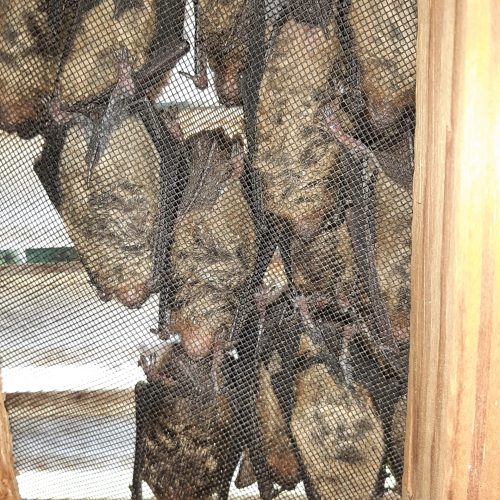
We conduct a full exterior inspection at dusk when possible — watching emergence points to confirm active entry locations. We also inspect the attic to assess colony size, guano accumulation, and structural damage. You receive a written report with photos.
2. Exclusion device installation
We install one-way exclusion tubes or netting at all confirmed entry points, allowing bats to exit but not re-enter. Secondary and potential entry points are sealed permanently at this stage. A missed gap means the colony finds an alternative route — we don’t leave gaps.
3. Monitoring and final seal
We return after several days to confirm the colony has fully exited, then permanently seal the primary exclusion points. We don’t close out the job until the bats are out and every point is locked down.
4. Guano assessment and remediation
Bat guano carries Histoplasma capsulatum, a fungal spore that can cause respiratory illness in humans. If there’s significant guano accumulation in your attic, we’ll assess the extent and walk you through remediation options. We’ll tell you honestly whether your job requires it.
It’s not uncommon for Durham homes to have more than one species using the same entry points. If you’re also hearing daytime activity in your attic, see our squirrel removal page — we’ll assess both on the same inspection.
Common Bat Species and Entry Points in Durham, NC
Big Brown Bat (Eptesicus fuscus)
The most common bat in NC and the most frequent call we get in Durham. Big brown bats roost in colonies of 20 to several hundred. They prefer attics and wall voids with southern or western exposure for warmth. Durham’s older housing stock near downtown, Duke East Campus, and the Watts-Hillandale neighborhood is particularly vulnerable — older wood, more developed roofline gaps, and decades of minor structural settling that opens entry points over time.
Little Brown Bat (Myotis lucifugus)
Less common but present in Durham, particularly in homes near Duke Forest and the Eno River corridor where wooded habitat is dense. Little brown bats form smaller colonies but can enter through gaps as small as 3/8 of an inch.
Common Entry Points in Durham Homes
- Ridge cap gaps — the most common entry point, especially on older homes where cap shingles have lifted or separated over time
- Soffit returns at roofline intersections — where two rooflines meet and a gap forms
- Chimney chase covers — deteriorated metal covers leave gaps bats exploit easily
- Gable vents — older or damaged vents without proper screening
- Fascia board gaps — common in Durham’s older housing stock where wood fascia has weathered or warped
- Roof-to-wall transitions — common in homes with dormers or additions
Bat Removal in Durham, NC — Frequently Asked Questions
When is bat exclusion allowed in North Carolina?
Two restrictions apply. NC law prohibits exclusion between May 1 and July 31 during bat maternity season — bat pups cannot fly during this period and sealing them in is illegal. Bats also do not fly when temperatures drop below 50°F, making exclusion ineffective during cold winter months. The optimal exclusion windows in central NC are August 1 through mid-November, and March through April 30.
Can you do bat exclusion in winter?
No — not when temperatures are consistently below 50 degrees Fahrenheit. Bats don’t fly in cold temperatures, so one-way exclusion devices won’t work. If you call us in winter, we’ll inspect your home, document all entry points, and schedule you for the earliest appropriate weather window. You won’t lose your place in the queue.
How much does bat removal cost in Durham, NC?
Cost depends on colony size, number of entry points, accessibility, and whether guano remediation is needed. We provide a written estimate after inspection — no surprises and no pressure.
Are bats dangerous to have in my attic?
Yes — for two reasons. Bat guano accumulates fast and carries Histoplasma capsulatum, a fungal spore that becomes airborne when disturbed and can cause a serious respiratory illness called histoplasmosis. Bats are also a primary wildlife carrier of rabies in NC. Direct contact should always be avoided. If you or a family member has had potential contact with a bat, contact your local health department immediately.
Will bats come back after exclusion?
Not if the exclusion is done correctly. Bats are creatures of habit and will attempt to return to a known roost. That’s why we seal every confirmed and potential entry point — not just the primary one. Our exclusion work is guaranteed: if bats re-enter through a point we sealed, we come back and fix it.
Schedule Your Durham Bat Removal Inspection
Bat problems don’t resolve on their own. The colony grows, the guano accumulates, and the structural damage at entry points gets worse every season. Even if we can’t perform exclusion right now due to timing or temperature, getting the inspection done means you’re ready to move the moment the window opens.
We serve all of Durham and Durham County. Same-day inspections are available. Call (919) 584-8650 or use the form below.
Already resolved the bat issue and looking for ongoing home protection? We also offer recurring pest control services in Durham with quarterly and monthly plans.